Sunday Telegraph - a misleading article on dietary fibre
In a nutshell
Misrepresents official guidance - ignores age-weighted average population recommendations
Advocates for one-size-fits-all diet - no mention that sensitive individuals can be harmed by dietary fibre
Subtly promotes highly processed plant-based diets - no mention of nutrient-dense meats
This is my latest article on topics in food and lifestyle from popular news outlets. You’ll find a list of my past articles at the end.
Previously I’ve highlighted positive, evidence-based messages we can benefit from. Unfortunately, a recent article the British Sunday Telegraph entitled We need more fibre in our diet – here’s how (and why) is misleading and oversimplifies a complex topic.
I’ll cover the following:
The regulatory context for the article
The ongoing debate around the need for dietary fibre
Where the article falls short and is misleading
The regulatory context for the article
The Telegraph article repeatedly cites a recommendation of 30g of dietary fibre per day. This stems from the 2015 report by the British Scientific Advisory Committee on Nutrition (SACN) entitled “Carbohydrates and Health”.
Unfortunately, the article misrepresents this as a blanket target for everyone, which it is not (I explain below).
The ongoing debate around the need for dietary fibre
A few years ago, after reviewing the evidence, I concluded that dietary fibre isn't essential for everyone. At that time I wrote about what changed my mind:
A notable clinical trial showed that a diet high in fermented foods increased gut microbiota diversity (commonly considered healthy) and improved immune function more than a high fibre diet
Traditional Inuit populations have thrived for generations primarily on animal-based diets, very low in plant fibre
Modern western carnivores report sustained good health without plant fibre
Historical data show that human height declined as plant-based food was consumed more regularly
So many of my vegetarian friends have IBS and try to reduce dietary fibre
I do include some fibre in my diet but I remain convinced that it isn’t universally required and for some it can be harmful.
Where I think the article falls short and is misleading
The Telegraph piece misleads in several key ways because it:
Presents the 30g average as applying to everyone, ignoring age-based advice
Fails to distinguish between soluble and insoluble fibre
Overlooks fundamental individual biological variability
Ignores evidence that fibre can harm some people
Subtly promotes a one-size-fits-all, highly processed, and plant-based bias
30g recommendation
SACN's 30g/day is an average population target for adults, scaled down for children and teenagers, as follows:
Children aged 2 to 5 years - approximately 15g/day
Children aged 5 to 11 years - 20g/day
Children aged 11 to 16 years - 25 g/day
Adolescents aged 16 to 18 years - about 30g/day
Adults - 30g/day
This is a graduated scale, not a universal 30g recommendation. It is not a personal prescription, and the report does not claim that these levels are optimal or necessary for every individual. The report also emphasizes sourcing fibre from a variety of whole-food sources, and acknowledges that evidence for benefits comes from mixed dietary patterns.
The difference between soluble and insoluble fibre
This distinction is important – it can differentiate between benefit and harm.
Soluble fibre (I’ve previously described as microbiome accessible carbohydrates or MAC) dissolves in water and is fermented by our gut microbiota resulting in various metabolites, potentially including beneficial short chain fatty acids (SCFA). Insoluble fibre remains intact, potentially aiding bowel transit and relieving constipation. It is not fermented and is eliminated as fecal matter (Table 1).
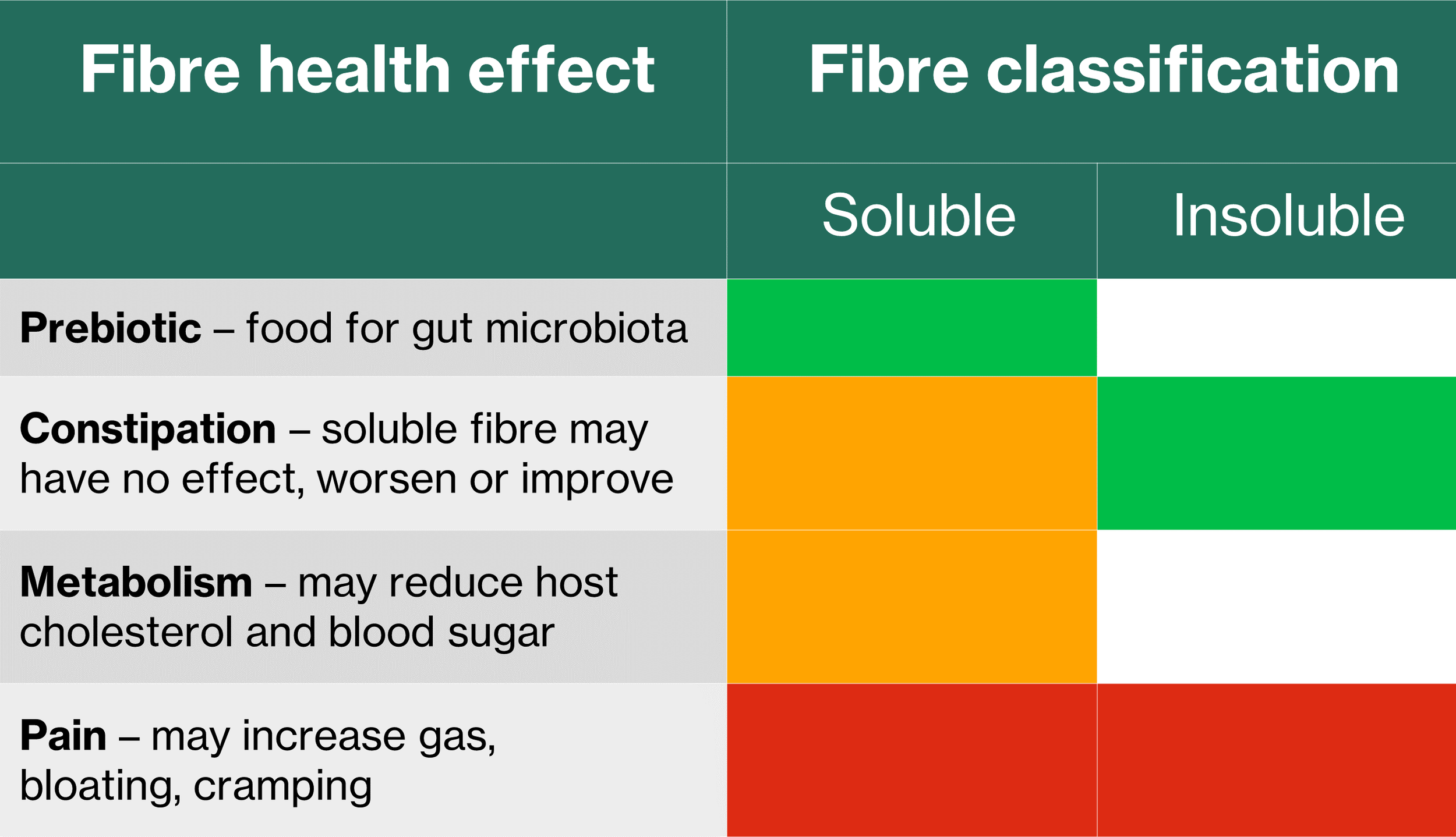
Table 1: Classification of fibre types and effects. Green = mostly positive; amber = mixed; red = potentially harmful; clear = no effect
Table 1 also highlights that both types can contribute to physical discomfort or pain in sensitive individuals. Understanding your personal response is crucial.
Individual variability
There is no single “proper human diet”. There is only a proper individual diet. Each of us is biologically unique - even identical twins differ at molecular, biochemical, and physiological levels. It follows, therefore, that "one-size-fits-all" approaches to nutrition, medicine, and public health generally are fundamentally flawed and often harmful.
If you’re not convinced, consider the following:
How have Inuit populations thrived on near-zero plant fibre in the Arctic?
How do modern carnivores stay healthy on a plant-free diet?
Whilst the recommendations cited above recommend fibre for all (surprisingly, I don’t agree with that), they differentiate between age-groups
The harmful effects of too much fibre
For some, either type of fibre exacerbates irritable bowel syndrome (IBS) symptoms or worsens inflammatory bowel disease (IBD). Reducing or eliminating fibre has helped sensitive individuals [1].
Subliminal pro-vegetarian/vegan recommendation
The article never acknowledges that fibre can fit into a balanced omnivorous diet - combining nutrient-dense, bioavailable animal foods with selective plant sources for desired fibre benefits (as in Table 1).
Instead, it includes an image of a shopping basket filled with vegetables, high-carb bread, and tins of highly processed baked beans - reinforcing a plant-heavy, processed narrative.
Summary
This Telegraph article is misleading in two important ways. It perpetuates the questionable, albeit not yet widely rejected, idea of a single “proper” human diet, and it ignores solid evidence that dietary fibre harms some people. Nutrition is deeply personal - listen to your body and be wary of one-size-fits-all headlines.
References
Kuffa P, et al Fiber-deficient diet inhibits colitis through the regulation of the niche and metabolism of a gut pathobiont Cell Host & Microbe, 2023; 31, 2007-2022.e12
Additional popular press articles
2025 - Wall Street Journal, Positive results of eliminating ultra-processed-food for one month
2025 - Sunday Telegraph, The six signs that you may have a food addiction
2025 - Daily Mail, Nutrient-Dense Low Carbohydrate Diets Outperform GLP-1 Drugs for Weight Loss
2025 – Daily Mail, Carnivore diet replaced drugs for ADHD and Depression
2025 - Guardian, A lack of vitamins and minerals from food increases NHS hospital admissions
2024 - Sunday Telegraph, “…a healthy brain requires a meaty diet”