The Truth About Raw Drinking Milk - Why it is Safe and Healthy
In a nutshell
High-quality raw milk is linked to less asthma, allergies, eczema, and better gut health
It is no riskier than leafy greens, chicken, oysters, or pasteurised milk
Safety depends on rigorous on-farm hygiene, animal health, and regular testing - not heat treatment
This is the second in a four-part series about raw milk:
The Truth About Raw Milk
Producing raw milk safely
Buying raw milk legally
As I wrote this article I was struck by the name “raw” milk. Growing up in rural Scotland (where I fetched milk from the farm in a metal pail for my great grandmother) we called it milk. I wonder why we don’t refer to vegetables (e.g., baby carrots, celery, etc.) we dip in humus as “raw” vegetables? The same goes for “wild” swimming. Back in the day it was just swimming.
The need to label milk as “raw” says a lot about how far we’ve drifted from traditional food. In my first article, I explained the critical difference between two very different products that both happen to come from a cow (or a goat, etc.):
Raw drinking milk - Produced in limited volumes, with strict hygiene, frequent testing with the intention that it will be consumed unprocessed
Industrial milk - Mass produced, high-volume, food substitute relying on pasteurization to compensate for unhygienic practices rather than preventing contamination in the first place. Nutritional quality is sacrificed for yield and shelf life
Without this distinction, any conversation about the health effects of raw milk is meaningless. The data I’ve reviewed supports the view that high-quality raw milk produced with strict standards of on-farm hygiene and regular testing is as safe as pasteurised milk and offers protection against certain chronic diseases.
I’ll discuss:
The potential benefits and hazards of safe raw milk
Comparing the safety of raw and pasteurised milk
The key to safety – production quality
Weighing the pros and cons
Benefits and hazards of safe raw milk
Benefits
High quality raw milk supports the immune system and provides beneficial gut probiotics. Childhood exposure appears especially valuable.
The Raw Milk Institute (RMI) is an excellent source of information and summarise research-backed benefits as :
Lower rates of asthma and allergies
Less eczema
Lower rates of ear infections, fevers, and respiratory infections
Increased abundance of probiotic Lactobacillus in the gut
I’m going to focus on asthma, allergies, and beneficial gut probiotics.
A large body of research from Europe (mostly) and America, consistently links raw milk consumption with reduced risk of asthma, allergies, and eczema [1]. Key studies include:
Greece, 2001 - In Crete, the consumption of unpasteurised milk by children was shown to protect against exaggerated immune responses, independently of having contact with farm animals and living in the countryside
Switzerland, 2001 – When they consumed raw milk in their first year of life, children living on farms were subsequently less likely to suffer from asthma or an exaggerated immune response. This effect was independent of living on a farm. An exaggerated immune response to harmless things such as pollen or certain foods, can result in conditions such as asthma, eczema, and hay fever, for example
Great Britain, 2006 – In English children living in the country, raw milk consumption was shown to be protective against exaggerated immune responses and eczema, but not asthma
Switzerland, 2007 – In a follow-up study, consumption of raw milk resulted in significantly fewer instances of asthma, hay fever-like symptoms, and exaggerated immune responses. This was observed in farming and non-farming families
Germany, Austria, Switzerland, 2011 - Reported consumption of raw milk in early life was associated with reduced risk of exaggerated immune responses, hay fever, and asthma in school-aged children
Poland, 2013 - Consumption of raw milk in the first year of life reduced risk of exaggerated immune responses in adulthood and even more so in children, independent of where they lived
US, 2017 - In a study of older adults in US farming communities, consumption of raw milk in childhood reduced the later probability of exaggerated immune responses
Proteins (including enzymes and antibodies) in raw milk appear to be key drivers of these benefits [2,3]. While milk fats survive pasteurization, the bioactive proteins do not.
Procedures such as homogenization which break up fat globules in raw milk may also diminish its value.
It is well understood now that humans and all other animals and plants on earth have evolved alongside important symbiotic microorganisms, referred to as their microbiota. In this relationship, we act as the host upon and within which our microbiota live and work with us cooperatively. It is still unclear what exactly constitutes a ‘healthy’ gut microbiome, although certain bacteria are associated with better health. Lactic acid producing bacteria (e.g., Lactobacillus and Lactococcus) found in popular ferments like kefir, kimchi, and sauerkraut, for example, are considered to have probiotic properties. A probiotic is a live microorganism which confers a health benefit when consumed (in our diet or a capsule).
A 2020 multi-disciplinary study found that regular consumption of raw milk and other raw dairy dramatically increased probiotic lactic acid bacteria (such as Lactobacillus and Lactococcus) and improved levels of beneficial short-chain fatty acids (SCFAs) in participants’ guts [2].
Hazards – a realistic assessment
The main negative effects of raw milk are short-term infectious illnesses, with pathogenic E. coli (especially STEC strains that produce Shiga toxin) being the biggest concern [3]. However, these same pathogens also appear in meat, leafy greens, and other foods.
Comparing the safety of raw and pasteurised milk
Raw drinking milk
When benchmarked against other common foods, high-quality raw milk is remarkably safe (Figure 1).
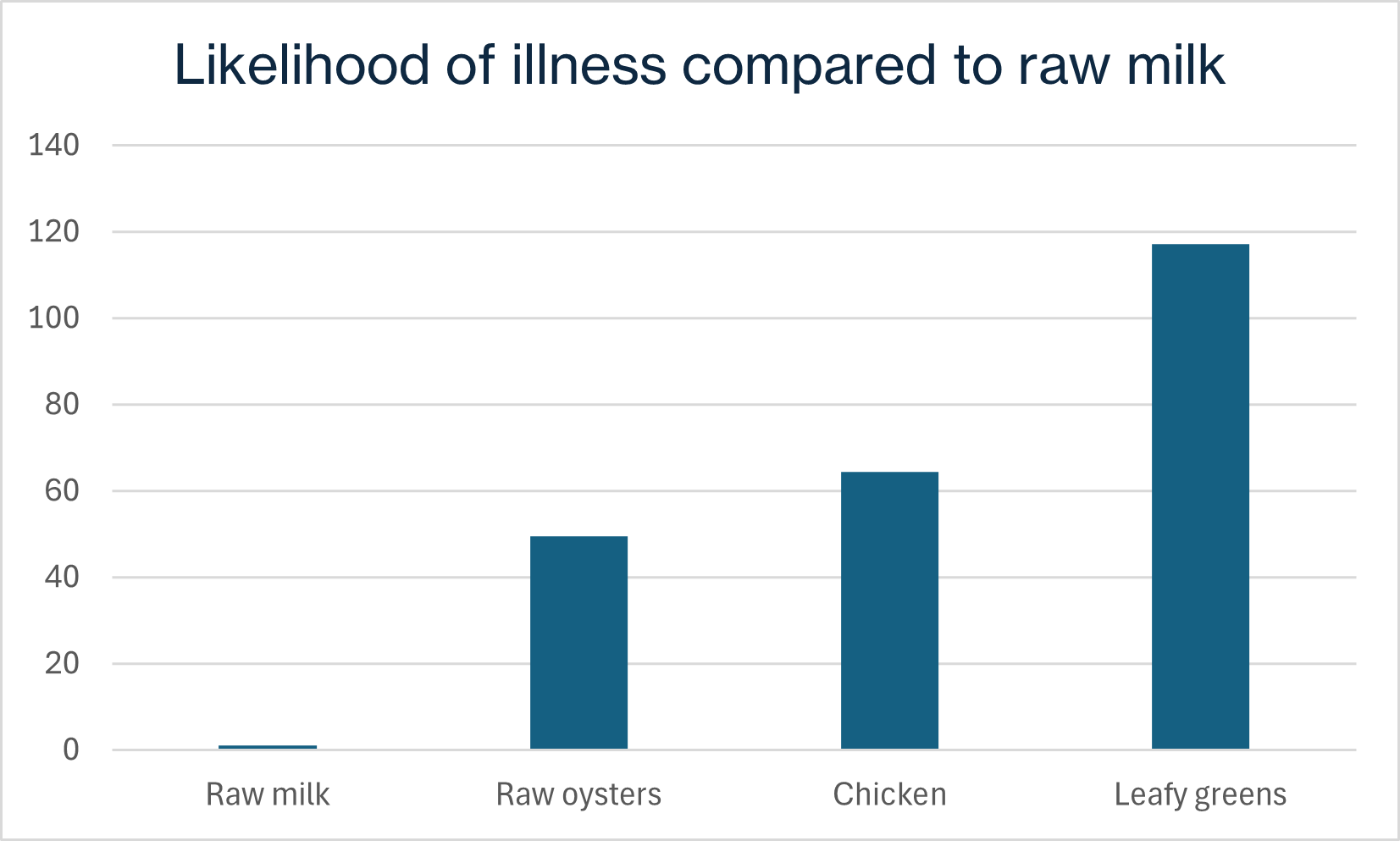
Using U.S. data on illnesses per consumer per year (raw milk set as baseline = 1):
Raw oysters: ~50x higher risk
Chicken: ~64x higher risk
Leafy greens: ~117x higher risk
Illnesses range from a mild stomach ache to hospitalization.
Plant-based foods consistently show up as higher-risk categories – see below.
Note that the data for raw milk likely represents a worst-case scenario. In the words of the article’s author:
“These numbers are spread across all farms. Modernized and sanitized farming operations, high performing, low performing, and the most rustic cottage industry offerings all get thrown into the same dataset. Identifiable sanitation errors in production lead to virtually all cases where illness can be conclusively attributed to a raw milk product. If a person is healthy and consuming raw milk from a clean source, the personal risk is assumably lower than the data above.”
Pasteurised milk
Even pasteurised milk is not risk-free (no food is) [4]. Over a 15-year period in the U.S. (2005 - 2020), it was linked to three deaths. Spinach, cucumbers, peanut butter, and cantaloupe all showed higher death (Figure 2).
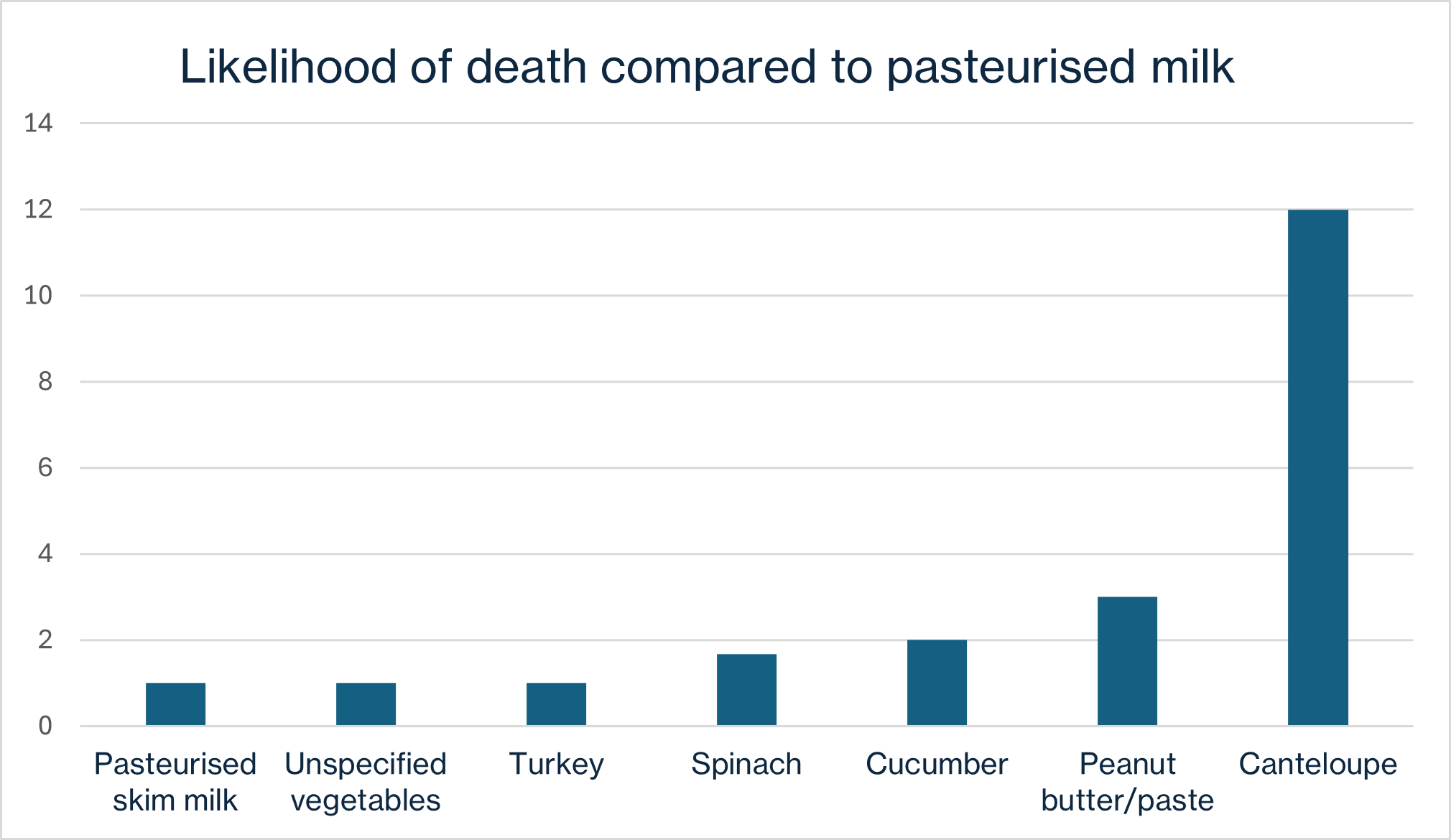
Figure 2: US food disease outbreaks reporting more than two deaths (2005 – 2020)
Comparing raw and pasteurised milk
A direct comparison of additional 2025 – 2020 data (Table 1) again from reference 4 yields :
Raw and pasteurised milk caused roughly similar total illnesses (~2,000 each) and deaths (2–4 each)
Raw milk was associated with more reported outbreaks and hospitalizations, but overall serious risk profiles are comparable
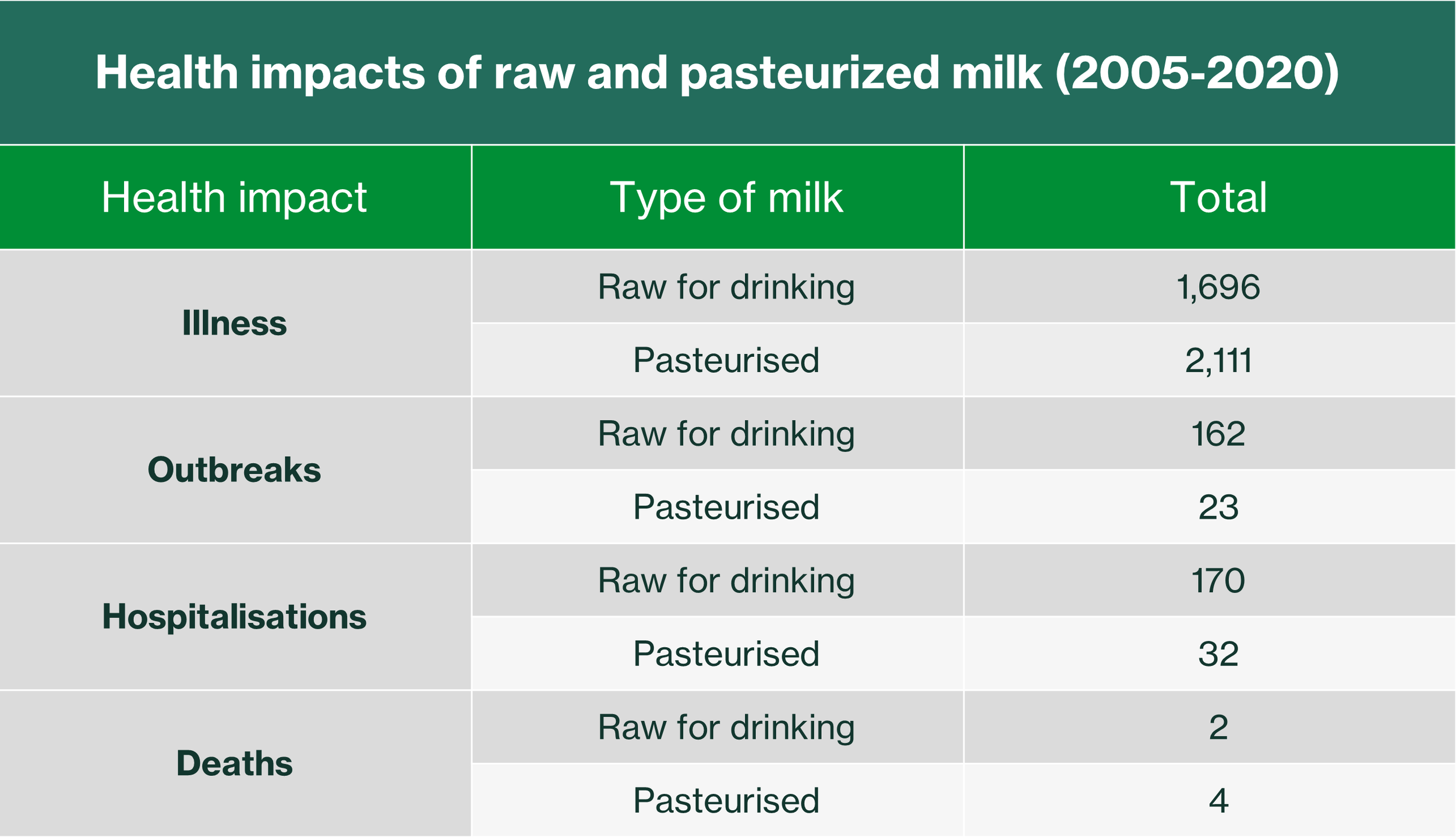
Table 1: Numbers of illnesses, outbreaks, hospitalizations, and deaths for raw and pasteurised milk (2005–2020)
It’s not clear to me why plants consistently show up as riskier than milk, raw or pasteurised. In my limited reading of the literature on leafy greens, for example, the complexity of an extensive supply chain apparently makes it difficult to apportion root cause [5].
The key to safety - production quality
Pasteurization was designed to compensate for dirty production methods. It does not make milk perfectly safe – there is no such thing as perfectly safe food - and it destroys beneficial proteins and probiotics.
In contrast, raw milk produced with rigorous animal health management, excellent hygiene, and frequent pathogen testing is safe. Aggressive hygienic practices and regular monitoring significantly reduce the risk of harmful E. coli.
In a discussion of effective methodologies specifically aimed at addressing the risk of poisonous E. coli [3] the following conclusion is reached :
“Risk reduction of STEC concentration in raw milk and its products can be achieved by aggressive hygienic practices and periodic monitoring of the milk.”
Weighing the pros and cons
We already accept risk in far more dangerous foods because we value their nutrition. The 1996 Scottish E. coli outbreak from meat pies caused ~500 illnesses and around 20 deaths - yet cooked meat was never banned. The 2006 U.S. spinach outbreak caused multiple deaths and hundreds of illnesses - yet spinach remains on supermarket shelves.
Raw milk deserves the same sensible approach.
Safe, raw drinking milk
A casual observer might conclude that because raw drinking milk is as safe as pasteurised and considerably less risky than many meats, fruits, and vegetables, it is perfectly safe to drink. This would miss the point that certain groups are generally more at risk from external influences plus each of us is different and should figure out for ourselves what is good for us and our loved ones.
There are two seemingly contradictory streams of evidence to reconcile. Can consuming raw drinking milk reduce the incidence of chronic diseases such as allergies and asthma? Can the consumption of raw milk cause short-term infections? The answer to both is “yes”, so how do we proceed?
I like Dr. Thomas Malone’s answer to this conundrum:
“The risk–benefit balance, therefore, hinges less on the existence of risk than on how low-probability acute harms are weighed against higher-probability reductions in chronic disease, as well as on confidence in production quality and handling practices.”
Certain groups should always be more cautious about what they eat. I refer to the American dietary guidelines updated in 2026 for a safety framework. Those guidelines suggest that children generally, pregnant women, lactating women, older adults, those with chronic disease, vegetarians, and vegans should be careful. I fall into the “older adult with chronic heart disease” category myself, so I weigh these factors carefully.
Summary
I will consume raw drinking milk when I can because it’s safe and nutritious.
In my opinion, three things prevent more wide-spread consumption. Many “accept the unacceptable because it is normal” and this has led to widespread consumption of industrially processed food. Also, outdated science is preventing many from appreciating the value in natural probiotics from things like kefir, kimchi, and raw milk.
Accepting the unacceptable arises because of the extinction of experience. It’s part of a wider problem in which we’ve moved away from real, nutrient dense food in favour of an unhealthy industrially processed diet.
Pasteurised milk is just another modern natural food substitute designed for maximum production volume to the detriment of life-enhancing nutrition. When consumed regularly, they lead to a number of chronic diseases.
The outdated science I refer to is the 19th century germ theory in which “germs” such as fungi, bacteria, viruses, and protozoa cause infectious diseases. We now understand that “germs” are in fact a small subset of microorganisms which are largely beneficial, and without which we’d die. We refer to these microorganisms as our microbiota.
In my next article I’ll cover what Robert Malone describes as “…confidence in production quality and handling practices”.
References
Sozańska B. Raw Cow's Milk and Its Protective Effect on Allergies and Asthma. Nutrients. 2019 Feb 22;11(2):469. doi: 10.3390/nu11020469. PMID: 30813365; PMCID: PMC6413174
Butler, M.I.; Bastiaanssen, T.F.S.; Long-Smith, C.; Berding, K.; Morkl, S.; Cusack, A.-M.; Strain, C.; Busca, K.; Porteous-Allen, P.; Claesson, M.J.; et al. Recipe for a Healthy Gut: Intake of Unpasteurised Milk Is Associated with Increased Lactobacillus Abundance in the Human Gut Microbiome. Nutrients 2020, 12, 1468. https://doi.org/10.3390/nu12051468
Baars, T. (2013). Milk consumption, raw and general, in the discussion on health or hazard. Journal of Nutritional Ecology and Food Research, 1(2), 91–107. https://doi.org/10.1166/jnef.2013.1027
Stephenson, M.M., Coleman, M.E. & Azzolina, N.A. Trends in Burdens of Disease by Transmission Source (USA, 2005–2020) and Hazard Identification for Foods: Focus on Milkborne Disease. J Epidemiol Glob Health 14, 787–816 (2024). https://doi.org/10.1007/s44197-024-00216-6
Marshall KE, Hexemer A, Seelman SL, Fatica MK, Blessington T, Hajmeer M, et al. Lessons Learned from a Decade of Investigations of Shiga Toxin–Producing Escherichia coli Outbreaks Linked to Leafy Greens, United States and Canada. Emerg Infect Dis. 2020;26(10):2319-2328. https://doi.org/10.3201/eid2610.191418